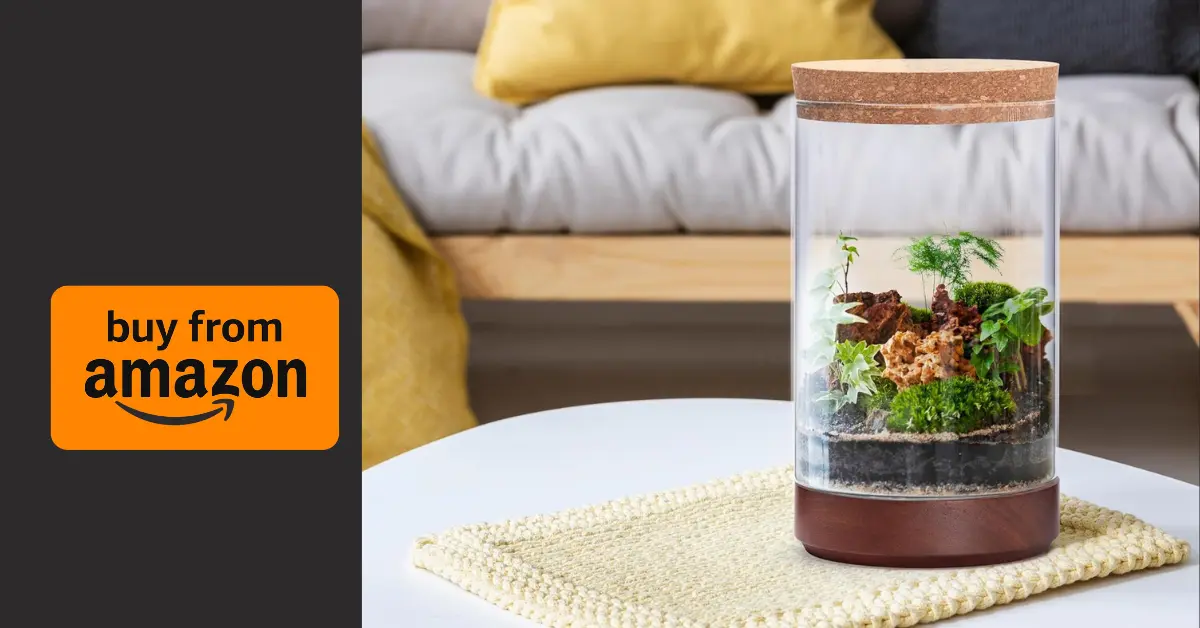
A clear glass houseplant terrarium planter can make an attractive desk display, but its appearance does not guarantee easy plant care. The cylindrical planter described in this article is marketed with a wood base and cork-style lid. The most important buying questions are whether the vessel has drainage, how easily you can reach the plants, and whether a covered environment suits the species you want to grow.
Thank you for reading this post, don’t forget to subscribe!
What makes a cylindrical planter useful?
A clear-sided container makes the arrangement visible from several angles, while a simple cylindrical shape can fit shelves and desks. However, the narrow opening or tall sides may make planting and pruning harder than in a wide bowl. Confirm the dimensions and included accessories against the current seller listing rather than relying on old product descriptions.
Check drainage before planting
Many decorative glass planters do not have a drainage hole. Water therefore stays inside until taken up by plants or lost through evaporation. A layer of gravel or charcoal does not remove it. For a beginner, a removable nursery pot inside a decorative outer vessel can be easier to manage where the dimensions permit.
What does the cork lid change?
A lid can slow moisture loss and create a more humid environment, which may benefit some tropical plants and mosses. It can also trap excess moisture if watering is heavy. Cork and wood components should be kept in suitable conditions according to manufacturer guidance; do not assume they are designed for constant contact with standing water.
Plant selection by setup
| Setup | Potentially suitable choices | What to avoid |
|---|---|---|
| Covered humid display | Compatible small tropical plants and suitable mosses | Dry-loving plants with incompatible needs |
| Open display | Plants that tolerate the available airflow and light | Assuming an open bowl has pot-like drainage |
| Water propagation display | Cuttings of species suited to water propagation | Assuming all plants thrive indefinitely in plain water |
Desk placement and light
Choose a location that meets the plants’ light needs without allowing the glass to overheat in strong direct sun. A desk away from windows may require a suitable grow light. Keep water away from computers, power strips, and cables.
How to prepare a simple display
- Inspect the glass for cracks and check that the base is stable.
- Choose plants with compatible light and moisture requirements.
- Clean the container and prepare suitable growing media.
- Leave space for roots, growth, and maintenance tools.
- Water conservatively if the vessel has no drainage outlet.
- Use the lid only if the plants benefit from higher humidity.
- Inspect the arrangement regularly for standing water and decaying leaves.
Limitations to consider
The principal drawbacks of a tall glass vessel are limited drainage, restricted access, and possible moisture exposure to decorative wood or cork. None of these makes the design unusable, but each affects which plants and care routine are sensible.
Frequently asked questions
Can I grow succulents with the cork lid on?
Most common succulents are better suited to good airflow and a growing medium that dries appropriately. A persistently humid closed setup is usually a poor match.
Does charcoal prevent overwatering?
No. Charcoal does not replace drainage or correct excess water.
Can I use the planter for cuttings in water?
Some species can be propagated in water, but the container must be kept clean and the cutting’s needs should be checked individually.
Related reading
Explore our glass jar selection guide and open versus closed terrarium comparison.
Review transparency: This is a suitability and buying assessment based on the described product design. It is not a report of independent hands-on testing or a verified current-price comparison.
Related Terrarium Master guide
For container selection and planting considerations, see our bottle terrarium guide. Mini Terrarium in a Bottle.
Three realistic desk setups
Covered tropical display: a small humidity-tolerant plant in an airy medium, with room for leaves and a removable lid for maintenance. Open foliage display: a small plant in a nursery pot placed inside the glass vessel, if dimensions allow, so excess water can be drained outside the decorative container. Unplanted botanical display: stones and cleaned decorative materials where there is not enough light for living plants; avoid implying that plants will thrive without adequate light.
Drainage and watering: what actually happens
A gravel layer at the bottom of undrained glass collects excess water; it does not create an outlet. If roots reach a saturated layer, oxygen may become limited. Start with a restrained amount of water, monitor the root zone and avoid topping up simply because the surface looks dry. If the display is difficult to water precisely, consider a narrow-spout bottle or a removable inner pot.
What to measure before buying
| Measurement | Why it matters |
|---|---|
| Interior opening | Determines whether tools and plants can pass through |
| Usable height | Allows substrate depth and foliage clearance |
| Base footprint | Helps assess stability on a desk or shelf |
| Lid material and fit | Affects humidity, cleaning and maintenance |
Early warning signs after planting
Persistent dripping condensation, a sour smell, mushy stems or pooled water suggest that the setup needs attention. Brown dry margins may instead reflect heat, low humidity or irregular watering. Inspect the plant and root conditions before changing several factors at once. Keep the glass away from direct sun that can rapidly heat an enclosed display.
When this planter is not a good choice
A tall or fast-growing plant will soon press against the lid. Succulents and cacti generally require brighter light, stronger airflow and drying cycles than a sealed humid vessel provides. If maintenance access is narrow or the seller does not provide useful dimensions, choose a simpler wide-mouth container.